Charlotte properties feature heavy tree canopies, mature oak stands, and undulating red-clay topography that trap moisture after summer downpours. In areas surrounding the Little Sugar Creek Greenway, Freedom Park, and…
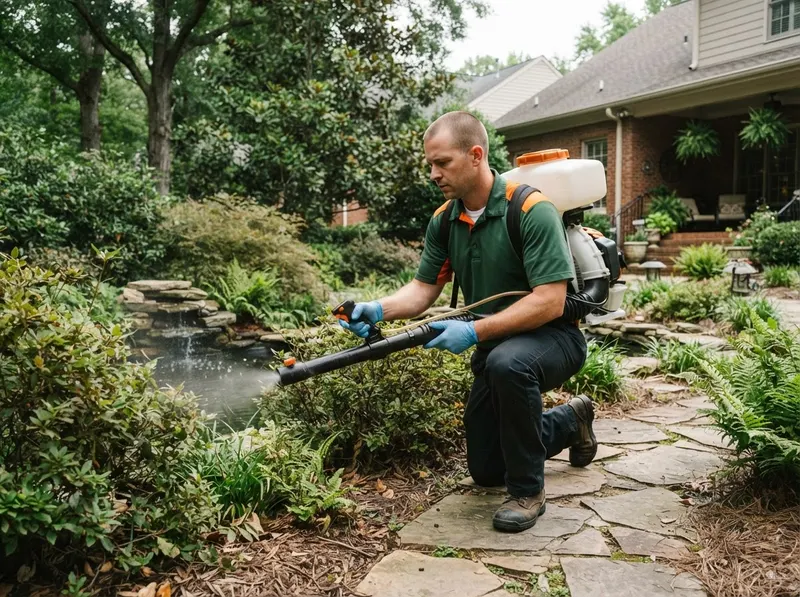
Charlotte properties feature heavy tree canopies, mature oak stands, and undulating red-clay topography that trap moisture after summer downpours. In areas surrounding the Little Sugar Creek Greenway, Freedom Park, and the UNC Charlotte Botanical Gardens, shaded pockets create ideal reproductive habitat for the invasive Asian tiger mosquito (Aedes albopictus). When high humidity settles over neighborhoods such as Myers Park, Dilworth, and Plaza Midwood, stagnant moisture collects in clogged perimeter gutters, corrugated downspout extensions, and low yard depressions. Targeted mosquito suppression resolves this vulnerability by addressing the reproductive source rather than relying solely on airborne chemical fogs that dissipate within hours.
Technicians systematically treat harborage areas on residential grounds, specifically targeting the shaded undersides of broadleaf shrubs, English ivy beds, and covered porch overhangs in South End and NoDa where adult mosquitoes rest during mid-day heat. Applying a weather-resistant microencapsulated adulticide creates a lasting protective zone that bonds directly to target foliage. For standing water located in birdbaths, French drains, saucers, and culverts across Cotswold, University City, and Ballantyne, operators apply biological larvicides containing naturally occurring soil bacterium Bacillus thuringiensis israelensis (Bti). Bti selectively disrupts the gut lining of mosquito larvae within 24 hours of ingestion, halting emergence before winged adults develop.
Targeted larvicide application fits properties featuring persistent shade, ornamental water fixtures, or dense foundation landscaping where mosquito populations replenish continuously. In contrast, standard single-event thermal fogging fits temporary outdoor weddings or backyard gatherings where an immediate knockdown is required for several hours, but fogging provides zero biological residual control against unhatched egg rafts. The operational trade-off of biological suppression is that it targets larval developmental stages over a 21-to-30-day lifecycle, requiring initial patience of 24 to 48 hours for maximum suppression as existing larvae perish. Homeowners receive safe, restorative outdoor living spaces that protect children and household pets from vector-borne insect bites without harsh chemical odors.
Every job gets a firm, written price after a free on-site visit.
Tell us about your targeted mosquito suppression and larvicide application job in Charlotte and we'll send a clear, written quote, usually the same day.
 SafeHaven Pest Control