Commensal rodents, specifically the Norway rat (Rattus norvegicus), roof rat (Rattus rattus), and house mouse (Mus musculus), rely directly on human habitations for shelter, water, and food. In Mecklenburg County,…
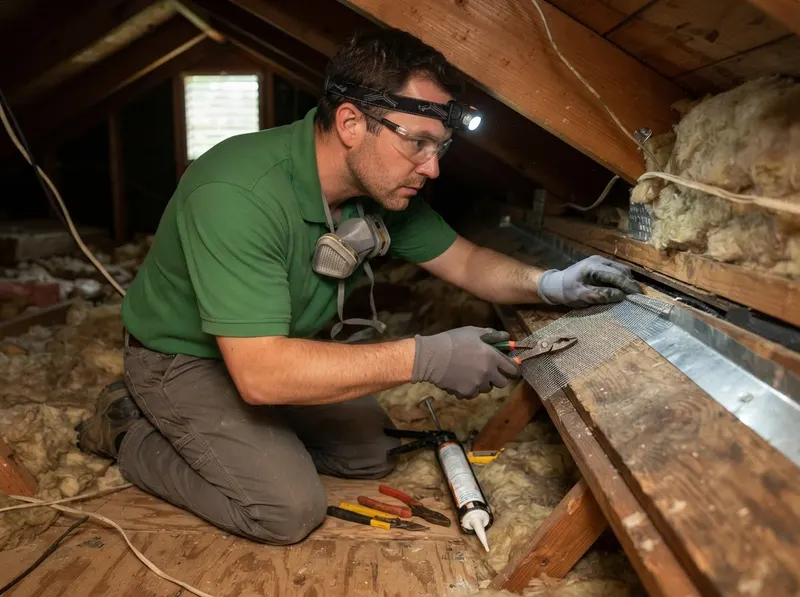
Commensal rodents, specifically the Norway rat (Rattus norvegicus), roof rat (Rattus rattus), and house mouse (Mus musculus), rely directly on human habitations for shelter, water, and food. In Mecklenburg County, these species exploit structural architectural vulnerabilities created by mature tree canopies touching rooflines and aging crawlspace vents. A standard chemical trapping program alone leaves underlying entry points open, which allows secondary rodent populations to repopulate the structure within 30 to 90 days. Mechanical exclusion permanently seals exterior penetration points using 19-gauge galvanized hardware cloth, copper mesh, and metal flashing. This physical barrier stops entry at roof transitions, soffit returns, and plumbing penetrations larger than 0.25 inches for mice and 0.5 inches for rats, avoiding continuous indoor poison applications near family living areas.
Attic remediation addresses the biohazard accumulation left behind in horizontal insulation layers. When rodents nest in ceiling insulation, they deposit urine, fecal matter, and pheromone trails that attract subsequent pests while degrading indoor air quality through attic-to-living-space air exchange. The stack effect draws roughly 30% to 50% of a home's indoor air upward from crawlspaces and downward through ceiling penetrations such as recessed can lights and attic hatches. Remediation requires HEPA-filtered vacuum systems to extract contaminated fiberglass or cellulose down to the ceiling joists, followed by an application of an EPA-registered broad-spectrum disinfectant. This mist neutralizes leptospirosis, lymphocytic choriomeningitis, and bacterial pathogens without leaving caustic chemical odors.
Structural requirements differ markedly across Charlotte architectural styles. Historic homes in Dilworth, Myers Park, and Elizabeth feature stone foundations, wide soffits, and mortared crawlspace vents that degrade over decades, requiring masonry patching and custom metal screen fittings. Mid-century and contemporary homes across Cotswold, South End, and Plaza Midwood often experience roof rat activity along tree-shaded fascia boards and HVAC roof penetrations. In newer suburban developments throughout Ballantyne and University City, builders frequently leave builder's gaps between roof decking and fascia board unsealed, creating direct attic corridors for roof rats navigating overhanging oak branches near the Little Sugar Creek Greenway.
Decision guidance depends on the current extent of biological contamination. If structural noise is isolated and droppings are limited to a localized 5-foot radius on top of dry insulation, mechanical exclusion paired with interior trapping resolves the issue while preserving existing insulation. If rodent urine has penetrated through the depth of blown insulation to the drywall ceiling, spot cleaning will fail because lingering pheromones cause new rodents to gnaw through exterior repairs. In these extensive cases, full attic insulation extraction, structural sanitation, and thermal re-insulation to current building code standards establish permanent home protection.
Every job gets a firm, written price after a free on-site visit.
Tell us about your commensal rodent exclusion and attic remediation job in Charlotte and we'll send a clear, written quote, usually the same day.
 SafeHaven Pest Control